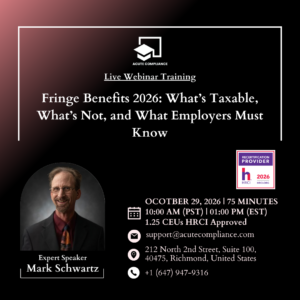
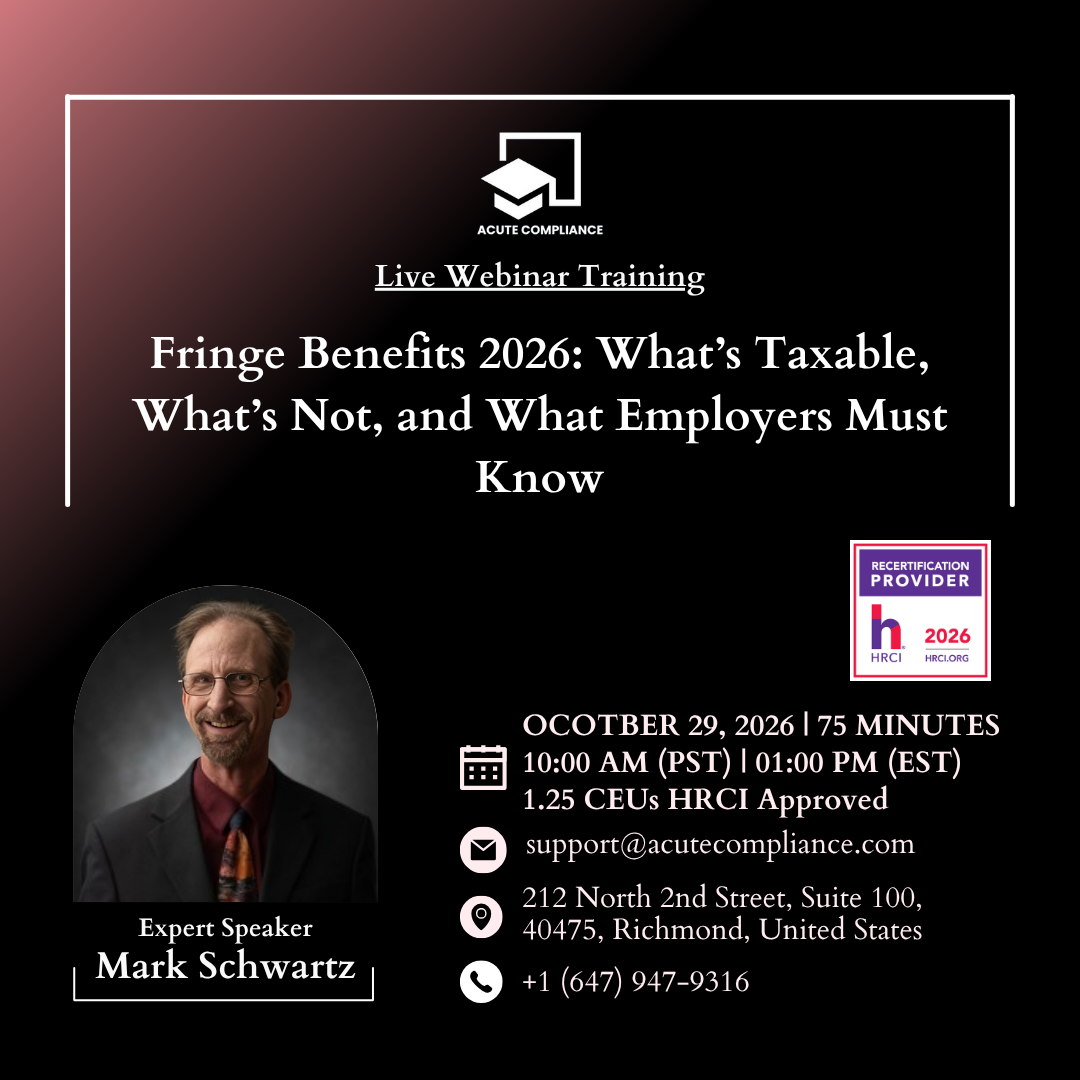
Fringe Benefits 2026: What’s Taxable, What’s Not, and What Employers Must Know

Date: October 29, 2026 | Time: 10.00 AM (PST) | 01:00 PM (EST)
Duration: 75 Minutes | Speaker: Mark Schwartz, Payroll Tax Consultant , MS Payroll
You can choose and select quantity from following webinar formats

Live
- +
$139.00
Recorded
- +
$149.00
E-Transcript
- +
$149.00
Live + Recorded
- +
$149.00
Live + E-Transcript
- +
$189.00
Live + Recorded + E-Transcript
- +
$229.00
Recorded + E-Transcript
- +
$189.00
Live (For max 5 attendees including recorded)
- +
$299.00
Live (For 5-10 attendees including recorded + e-transcript)
- +
$349.00
- +
Guaranteed Safe Checkout

There are lots of ways to reward workers other than wages. Smart businesses understand the two-way importance of helping employees out with things like education, commute help, health and wellness, etc. The IRS also recognizes the economically stabilizing results of fringe benefits. They have categorized the many different types of benefits, and set limits on which the value does not have to be taxed to the worker.

However, limitations exist on types and amounts of fringe benefits that are non-taxable to the worker. Making mistakes can result in audits, inquiries or assessments for unpaid taxes.

Why You Should Attend:

The OBBB enhanced provisions on many fringe benefits to the benefit of employees. These include Health, Education, Dependant Care and more. Learn the specifics and how long these provisions will last.

Specifically, IRS auditors are focusing on executive compensation. Stock options, golden parachutes, insurance and other perks are designed to keep your high priced executive talent in place. However, mismanagement of these benefits can subject you to not only payroll tax audits, but personal income tax audits for the executive.

Being both knowledgeable and choosy about which benefits you provide will go a long way in keeping workers motivated without breaking either your company’s or the workers’ budgets. Covid-19 has made certain choices more beneficial, as the government will pay for things like mandated sick pay.

The IRS has an entire booklet on all the various types of fringe benefits. How confident are you in the proper reporting and taxability of the ones you offer, or would like to offer?

Join Mark in this informative webinar. You will get the very latest maximum amounts and tax requirements announced for 2026, and much, much more.

Session Highlights/Course Objectives:
  1. Definition of Fringe Benefits, and how to distinguish them from expense reimbursements. The OBBB’s new and extended benefits to employees.
  2. What is new for 2026, including milage rates, commute benefits, parking and more?
  3. What is excludable from taxes and what you must withhold and pay payroll taxes on?
  4. Types:
    • Adoption Assistance
    • Athletic Facilities
    • De Minimus
    • Dependent Care Assistance
    • Educational Assistance
    • Employee Discounts
    • GTL Insurance
    • Lodging
    • Meals
    • Moving Expense
    • No Additional Cost Services
    • Transportation
    • Working Condition Fringe
    • Moving Expenses
    • Awards and Prizes
  5. Cafeteria Plans – what can and can’t be included
  6. Use of Company Vehicles for personal use, and company use of employee’s personal vehicles.
  7. How to properly value a fringe benefit
  8. How to properly tax a fringe benefit
  9. Executive Compensation
    • Stock Options
    • Deferred Compensation
    • Golden Parachutes
    • Statutorily Deductible Executive Fringe Benefits
    • Section 132 of the IRC
  10. Common errors to avoid.
  11. Rules of thumb for Fringe Benefit Administration
Who Will Benefit:
  • Payroll Managers & Payroll Administrators
  • HR Managers & HR Directors
  • Compensation & Benefits Managers
  • HR Generalists & HR Business Partners
  • Payroll & Tax Compliance Specialists
  • Accounting Managers & Controllers
  • Finance Directors & CFOs
  • Benefits Administrators & Benefits Specialists
  • Tax Managers & Employment Tax Professionals
  • Business Owners, Executives & Operations Managers

Expert Speaker

Mark Schwartz is an employment tax specialist and has over 15 years of employment tax experience as an independent consultant and as a payroll tax auditor with the State of California. He has managed an audit caseload of 20 ongoing audits, from small home-based businesses to large multi-national corporations. He is expert at defining regulatory and statutory requirements from local, State and Federal government agencies; and helping the average businessperson understand what that means to their business. He has processed weekly and bi-weekly payroll checks plus tax forms for businesses with hourly as well as exempt workers, multistate operations and a wide variety of benefits.

Mr.Schwartz provides consulting services encompassing payroll processing and payroll tax issues. These include payroll tax minimization, payroll tax compliance reviews, independent contractor studies, use of electronic transfers, deductions, benefits, etc. Mark has represented both clients and the State in front of the State Appeals Board. He understands the complexities of local wage laws, unemployment and disability claims, and other wage and benefit issues affecting your employees.

Mark prides himself on his outstanding customer service skills. He listens attentively to his clientele, helping them bridge the gap between the small business world and Government bureaucracy. He eagerly assists with clients needs and feels that educating clients toward faster, accurate and more complete payroll processes provide the most value.

Mark is a participating member of the American Payroll Association. He earned his BA and MBA in Finance at Santa Clara University. He has held Certified Internal Auditor and Certified Investment and Derivatives Auditor Credentials. Mark is currently pursuing a Certified Payroll Fundamentals Credential with the American Payroll Association.

Credits/Certification

1.25 CEUs/RCHs

HR (General) recertification credit hours toward aPHR™, PHR®, PHRca®, SPHR®, GPHR®, PHRi™ and SPHRi™ recertification through HR Certification Institute® (HRCI®). For more information about certification or recertification, please visit the HR Certification Institute website at www.hrci.org

Reviews

There are no reviews yet.

Be the first to review “Fringe Benefits 2026: What’s Taxable, What’s Not, and What Employers Must Know”

Your email address will not be published. Required fields are marked *

Shopping Cart
Fringe Benefits 2026: What’s Taxable, What’s Not, and What Employers Must KnowFringe Benefits 2026: What’s Taxable, What’s Not, and What Employers Must Know
From $139.00Select options
Scroll to Top